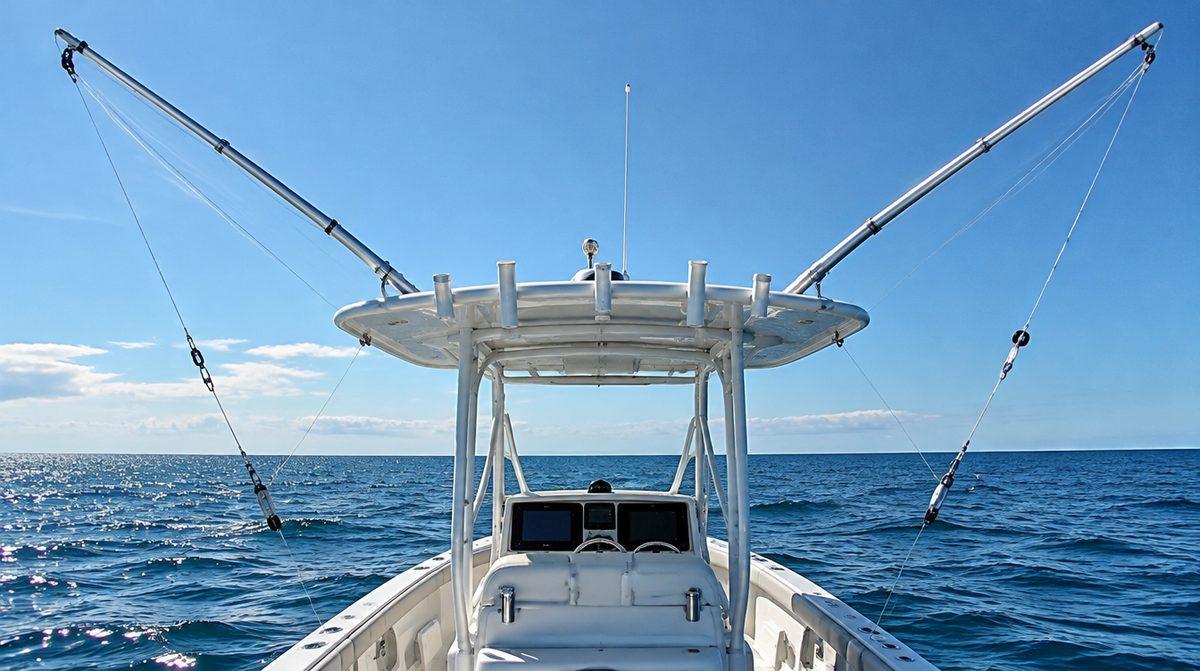
Outriggers: Spread More Lines and Raise More Fish
Two baits in the wake is a start. Outriggers put a whole spread out there: pole length, materials, mounts, and the rigging that makes them fish.
Run the docks at any serious offshore marina and you will see the same silhouette: long poles raked out over the water on every boat that trolls for a living. Outriggers are not decoration. They let one boat present a wide, organized spread of baits that covers more water, stays out of the prop wash, and keeps lines from tangling with each other. If you troll offshore, or want to start, riggers are the upgrade that changes how you fish.
How Outriggers Actually Work
An outrigger is a long pole mounted near the gunwale or on the hardtop, angled out over the water. A halyard, which is just a continuous loop of line, runs up the pole to a release clip. You put your trolling line in the clip, hoist it toward the pole tip, and your bait now swims far off to the side of the boat instead of straight behind it. When a fish eats, the line pops out of the clip, the slack comes tight, and you are fighting the fish on a direct line to the rod.
That release does two jobs. It moves the bait away from the boat, out where wary fish are more willing to eat, and it builds a brief moment of slack into the strike. On baits where the fish needs a second to turn and swallow, that drop-back puts more hooks in jaws than a tight line ever will.
Pole Length
Longer poles mean a wider spread and more room to stagger lines, but they also load the mounts harder and swing more in a seaway. The poles in this range mostly come in 15 and 18 foot lengths. A smaller center console running one line per side fishes 15 footers comfortably. A bigger boat running a full spread wants the 18 footers so every bait gets its own lane.
Think about storage too. Telescoping poles collapse for trailering, slip storage, and bridge clearance, and that convenience matters more than you expect the first time you idle toward a low bridge with the riggers still up. Fixed-length poles are simpler, with fewer moving parts to seize, but you live with the full length all the time.
Aluminum, Fiberglass, or Carbon Fiber
Aluminum is the standard: strong, reasonably light, affordable, and proven over decades of offshore abuse. An anodized finish holds up well as long as it gets a freshwater rinse.
Fiberglass is the budget-friendly route with a forgiving flex, though that same flex means more tip bounce in sloppy water.
Carbon fiber is the premium pick. It is lighter and stiffer, which translates to less whip at the tip, cleaner bait presentation in a swell, less strain on your mounts, and far easier handling when you deploy and stow the poles. You pay for all of that, but if you fish your riggers every weekend, the weight savings alone can justify it.
The Base Carries the Whole Load
An extended outrigger is a long lever, and a seaway works that lever all day. The mount matters as much as the pole. Bases need to be through-bolted with backing plates, not screwed into thin fiberglass, and the structure behind them has to be solid. Hardtop mounts feed the load into the top's frame; gunwale mounts feed it into the covering boards. Either way, confirm the structure can take it before you drill. If the mounting area is cored, or you are not sure what is under the surface, have a verified rigger on Waypoint take a look before you make holes you cannot take back.
Rigging Kits Turn Poles Into Fishing Gear
Bare poles do not catch fish. To actually fish them you need halyard line, release clips, and usually small pulleys and shock cord to keep tension on the loop. Rigging kits bundle all of it in one box. Buy quality clips with adjustable tension: set too light, the line pops free in the wake; set too heavy, a short-striking fish never pulls it loose. Rig a clip for each line you plan to run on the pole, and leave yourself enough halyard to work the clips from the cockpit without acrobatics.
Maintenance and Lifespan
Riggers live at full extension in salt spray, so give them the same rinse you give your rods. Flush telescoping sections with fresh water so salt does not lock them, and let them dry before you collapse them. Inspect halyards for chafe and fuzz, and replace them before they fail with a fish on. Watch the bases for corrosion stains and any new movement; a mount that has started to work loose only gets looser. The poles themselves last many years when the hardware is kept up, so most of your attention goes to line, clips, and fasteners.
Mistakes to Avoid
- Buying poles before confirming the mounting structure can carry them.
- Skipping the backing plates because the screws felt tight going in.
- Cheap release clips on a premium pole, which is how raised fish come unbuttoned.
- Running more lines than your crew can clear when a fish actually hits.
- Forgetting the riggers are up around bridges, boat lifts, and fuel dock canopies.
From the Water
Stagger your lines so the short baits run off the flat lines and the long ones come off the riggers. It cuts down on tangles in turns. In a turn, the inside baits slow down and sink while the outside baits speed up and rise, and a staggered spread gives everything room to slide without crossing. Set the same spread the same way every trip, and you will spend your time fishing instead of untangling.
Where to Get It
Everything in this guide is stocked at Boat Supplies Direct, the Nautical Network marine parts store. Orders ship free all year with Dock Pass, the $49 a year shipping pass.
In stock as this guide goes up: - TACO 18' Deluxe Outrigger Poles with Rollers, Silver/Silver - Lees 18' Telescoping Carbon Fiber Outrigger Poles for Sidewinder Mount - Tigress 15' Telescoping Fiberglass Outrigger Poles, White/Blue Pair
Browse the full range: - Shop outriggers - Read the full buying guide, including FAQs
More from the Wire
 Buying Guides
October 19, 2026
Boat Cleats: Small Hardware, Huge Loads
A cleat spends its whole life doing nothing until a storm asks it to hold your entire boat. How to size one to your dock lines, and why the mounting matters more than the metal.
Read more Buying Guides
November 20, 2026
Boat Stocking Stuffers Under $25: 15 Small Gifts Boaters Use
Koozies, decals, a floating keychain, a whistle, dock lines, and more: small gifts under twenty-five dollars that boat owners actually use.
Read more Buying Guides
November 10, 2026
Boarding Ladders: Getting Back Aboard Safely From the Water
The hardest part of any swim is the last three feet. How to size a boarding ladder so you can actually climb it, plus mounts, materials, and the solo-swimmer test.
Read more