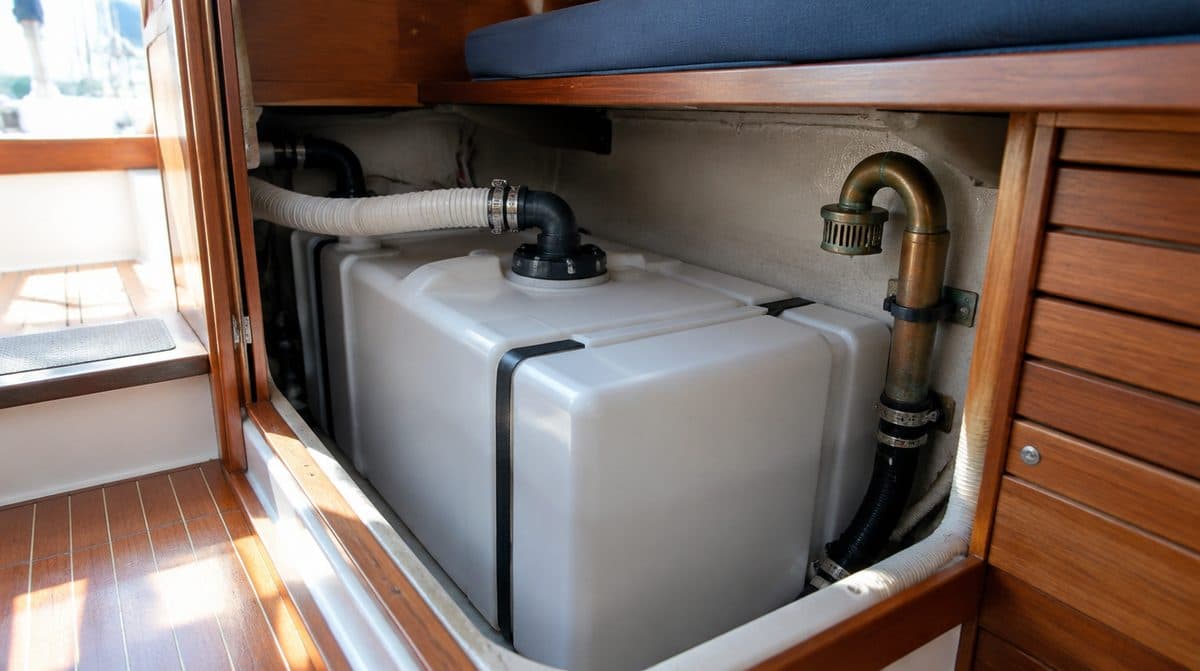
Holding Tanks: Size, Fit, and Keeping the Smell Away
Your nose knows before your guests do. How to size a holding tank, fit it into an odd space, and keep the whole system smelling like nothing at all.
A boat that smells like the head is a boat nobody wants to spend the weekend on. Most odor problems start at the tank. Not the toilet, not the crew, the tank: the wrong size, the wrong hose, a vent that cannot breathe, or a system that sat full in the summer heat. The good news is that a holding tank is one of the simplest systems on the boat once you understand what it actually has to do. Pick the right capacity, fit it properly, vent it correctly, and the head becomes a non-event, which is exactly what you want it to be.
How the System Actually Works
A marine sanitation system has fewer parts than most people expect. The toilet flushes through a run of sanitation hose into the holding tank. The tank has a vent line to a hull fitting so air can move in and out as the level changes. A deck fitting on top lets the pump-out station at the marina empty it. On boats that cruise where overboard discharge is legal, a Y-valve routes waste either to the tank or to a macerator pump that grinds and discharges it offshore.
Every one of those connections matters. Waste systems are unforgiving of sloppy plumbing: a sagging hose holds standing waste, a kinked vent builds pressure, and a cheap fitting weeps in a way you will smell long before you see it. When you shop for a tank, you are really shopping for a system, so think about the hose, vent, and fittings at the same time.
Capacity: Size by Crew and Days Aboard
Size by crew and days aboard. A rough planning figure is a few gallons per person per day. Bigger tanks mean fewer pump-out stops but take more space.
Here is how that math plays out. Say you take the family of four out from Friday evening through Sunday afternoon. Call that two full days of use, and call the planning figure two gallons per person per day to keep the arithmetic simple. Four people, two days, two gallons each: sixteen gallons before you are back at the dock. A fifteen gallon tank means you are hunting for a pump-out station on Sunday morning instead of swimming. A twenty gallon or larger tank gives you margin, and margin is the whole point.
If you mostly day-trip with two people, a smaller tank is fine and frees up storage. If you anchor out for long weekends, buy the biggest tank your space allows. Nobody has ever complained that their holding tank was too large.
Fit the Space
Tanks come in many shapes to fit odd spaces: low and wide for under a berth, tall and narrow for a locker, wedge-shaped for the turn of the bilge. Measure carefully and account for the inspection port, vent, and fittings. The tank dimensions on the spec sheet are the body of the tank. The fittings on top can add real height, and you need room above the inspection port to actually open it someday.
Also think about the hose runs before you commit to a location. The shorter and straighter the run from toilet to tank, the better the system works and the less hose there is to eventually permeate. Mount the tank on a flat, supported surface and strap it down. A full tank is heavy, and a tank that shifts in a seaway will find a way to stress its fittings.
Venting and Odor Control
Proper venting prevents pressure and odor. The bacteria that break down waste come in two varieties: the aerobic kind that work with oxygen and produce little smell, and the anaerobic kind that take over when the tank cannot breathe and produce the sulfur stink everyone associates with boat heads. A healthy vent keeps air moving and keeps the tank on the right side of that trade.
Run the vent line as straight as you can, without low spots that collect liquid and block airflow. Pair the tank with odor-resistant sanitation hose and a vent filter to keep the boat smelling clean. The hose matters more than most people think: bargain hose is permeable, and once odor soaks through the hose wall, no amount of cleaning fixes it. Buy proper sanitation-rated hose once instead of cheap hose twice.
Installation Realities
A few habits separate a clean install from a future project. Double-clamp every below-waterline connection. If your toilet or discharge plumbing runs below the waterline at any angle of heel, install a vented loop so water cannot siphon back aboard; a bronze vented loop in the discharge run is cheap insurance against a flooded head compartment. Keep hose runs smooth and continuously sloped toward the tank, because every sag becomes a trap that holds waste against the hose wall.
If you are adding a Y-valve for overboard discharge, mount it where you can actually reach the handle, and make sure you can secure it in the tank position where regulations require it. A macerator pump for offshore discharge should be self-priming and mounted close to the tank with the shortest practical suction run.
Maintenance and Lifespan
A holding tank itself lasts a very long time. The hoses, clamps, and fittings around it do not. Rinse the tank with fresh water after pump-outs when you can, and use a tank treatment if you like, though a well-vented tank needs less chemical help than the ads suggest. Check fittings and clamps each season for weeping and corrosion.
The classic test for tired hose: wipe a section with a clean rag dampened in hot water, then smell the rag. If the rag smells like the tank, the hose wall is permeated and it is time to replace that run. Other replacement signs include a tank that bulges when full, cracked or chalky fittings, and a smell that persists even after a pump-out and rinse. Any of those means the system is telling you something, and waste systems only get worse on their own.
From the Water
Pump out and rinse the tank before the boat sits for any length of time. Waste sitting in a warm tank is where the smell starts, and a few weeks of summer layup can undo a season of careful habits. Make the last stop of every trip the pump-out dock and the boat will always smell like a boat, not a bathroom.
Where to Get It
Everything in this guide is stocked at Boat Supplies Direct, the Nautical Network marine parts store. Orders ship free all year with Dock Pass, the $49 a year shipping pass.
In stock as this guide goes up: - Jabsco Y-Valve - Jabsco Sealed Macerator Self-Priming Pump, 12V - GROCO Bronze Vented Loop for 1 Inch Hose
Browse the full range: - Shop sanitation - Read the full buying guide, including FAQs
More from the Wire
 Buying Guides
October 19, 2026
Boat Cleats: Small Hardware, Huge Loads
A cleat spends its whole life doing nothing until a storm asks it to hold your entire boat. How to size one to your dock lines, and why the mounting matters more than the metal.
Read more Waypoint
October 13, 2026
One Search, Whole Boat Day: How to Build a Service Plan in Minutes
Transport Thursday, bottom clean Friday, A/C fixed before guests land Saturday. Here is how Waypoint turns one sentence into a full lineup of vetted pros.
Read more Buying Guides
October 29, 2026
Hot Showers Aboard: A Marine Water Heater Guide
Hot water underway is free once your heater has an engine loop. Tank sizes, heating sources, and what to measure before you order one.
Read more