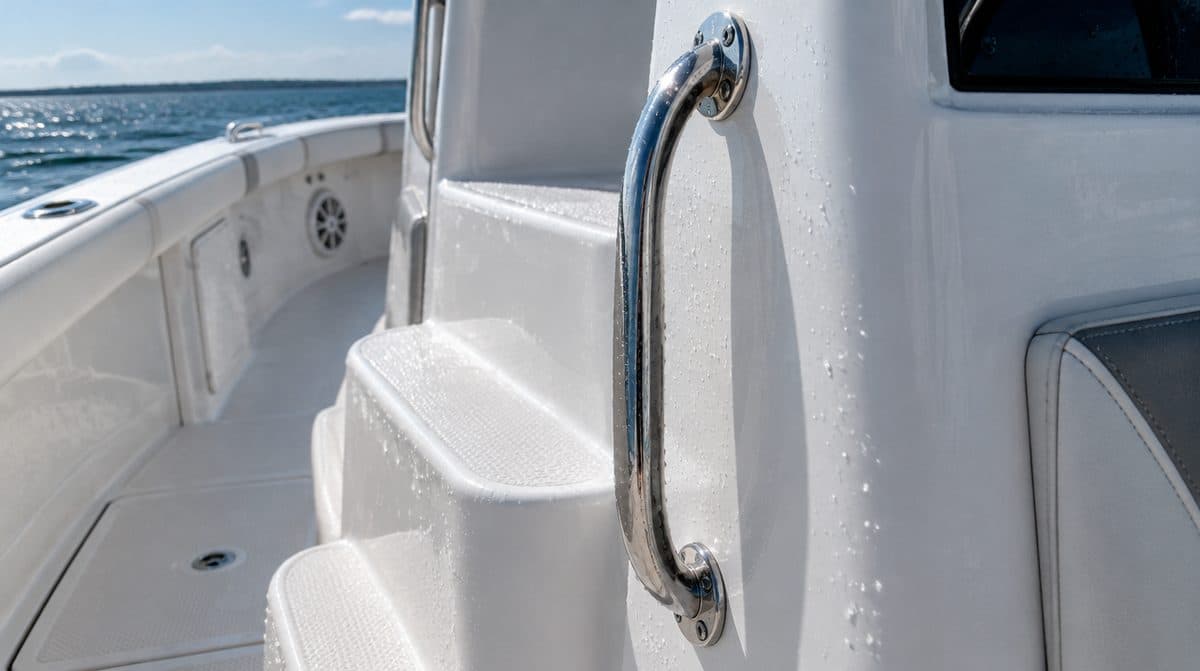
Grab Handles: Steady Footing in a Moving Boat
A hand shoots out the moment the boat lurches. What it finds decides whether anything happens next. Materials, placement, and mounting for grab handles that actually hold.
On a rough day, everyone aboard is looking for something solid to hold. The boat drops off a wake, a knee buckles, and a hand shoots out for whatever is closest. If that hand lands on a well-placed grab handle, nothing happens, which is exactly the point. If it lands on a rod holder, a windshield frame, or the back of your shirt, you have a problem.
Grab handles are some of the cheapest safety gear you can put on a boat, and some of the most ignored. Here is how to choose them, where to put them, and how to mount them so they hold when someone's full weight hits them without warning.
Why Handholds Are Safety Gear, Not Trim
Watch how people actually move around a boat underway. Nobody really walks. They move hand over hand, from one solid point to the next, timing their steps between waves. Every gap in that chain of handholds is a stretch where somebody is balancing on nothing.
The gaps matter most for the people not expecting the motion: kids, guests, anyone coming up from the cabin. You know when the boat is about to roll because you are driving it. They do not. A handle within reach turns a stumble into a non-event instead of a bruise, or worse, a person in the water.
More handholds mean a safer boat underway. It really is that simple.
Stainless, Coated, Nylon, or Teak
Material is the first decision, and it comes down to where the handle lives and how hard it will be loaded.
Stainless steel is the strongest and most corrosion resistant option, the standard for serious handholds. For anything on deck, anything that catches full body weight, or anything near the helm and boarding areas, stainless is the default. On saltwater boats, look for 316 grade; it shrugs off the salt air that slowly pits lesser stainless.
Nylon and polymer handles are lighter and cheaper, fine for light-duty interior grab points: a cabin step, a head compartment, a spot where someone steadies themselves rather than hangs on. They will never corrode, but they will not take the same abuse as metal either.
PVC coated handles split the difference: a rigid core wrapped in a softer grip that is kinder on cold hands and does not get blistering hot in July sun the way bare metal can.
Teak looks right on a classic boat and feels good wet or dry. It needs the same serious mounting as everything else and a little oil or cleaner now and then to stay handsome.
Where Handles Actually Belong
Place handles where people actually reach when the boat moves: at the helm, at steps, and at every transition.
- The helm area. The driver has the wheel to hold. The person standing next to them has nothing unless you give them something.
- Companionway and cabin steps. Going below in a seaway is one of the most common places aboard to fall.
- Boarding points. Transom, swim platform, and gunwale, anywhere people climb on and off, often with wet feet and full hands.
- Along walkways. Anywhere crew moves fore and aft while the boat is running.
- The head and galley, if you have them. Both get used underway, usually one-handed.
Getting the Size Right
Size every handle so a full hand fits with gloves on. A handle you can only get three fingers into is a handle that gets dropped the instant the boat lurches. Check the grip clearance too: there should be room behind the bar for knuckles, not just fingertips.
Single-grip handles like Sea-Dog's stud mount rails come in lengths such as 10 and 12 inches, right for one solid hand with room to spare. For walkways and cabin tops where people move along the boat rather than just bracing in place, a long multi-loop rail works better; Whitecap's 63 inch teak handrail with six loops gives a continuous handhold over several steps of travel.
Mounting: Through-Bolt or Don't Bother
Through-bolt with backing for any handle that takes real weight. A handle that pulls out is worse than none, because the moment it lets go, somebody was trusting it with everything they had.
- Use through-bolts, not screws, anywhere you can reach the back side.
- Add a backing plate to spread the load across the laminate instead of concentrating it on two bolt holes. Stainless or aluminum plate is ideal; generous fender washers are the minimum.
- Stud mount handles make the job cleaner: threaded studs pass through the deck and take a nut and washer below, with no exposed fasteners topside to catch lines or corrode.
Screws into bare fiberglass are acceptable only for decorative or genuinely light-duty interior handles that will never catch a falling adult.
Installation Realities
Two things trip up otherwise solid installs. First, cored decks: if yours has a balsa or foam core, drill the holes oversize, fill them with thickened epoxy, and redrill through the cured plug so a weeping fastener cannot rot the deck from the inside. Second, bedding: set the bases in marine sealant, snug the fasteners, let it cure, then do the final tighten so the sealant forms a gasket instead of squeezing out.
Maintenance and When to Replace
Grab handles are low maintenance, not no maintenance. Rinse stainless with fresh water and watch for brown tea staining or pitting around the bases, which means corrosion is starting where water sits. Give every handle a hard wiggle at the start of each season; any movement at the base means the sealant has let go and water is getting into the holes. Re-bed it before the deck pays the price.
Replace a handle when you see cracks in nylon or polymer (UV makes them brittle long before they look bad), corrosion at welds or bases on metal ones, or any flex you can feel. These parts are cheap. Deck repairs and emergency room visits are not.
Mistakes to Avoid
- Screwing down a handle you could have through-bolted.
- Placing handles where they look tidy instead of where hands actually reach.
- Buying one handle when the boat honestly needs five.
- Using a light-duty interior handle at a boarding point.
- Skipping the backing plate because the back side was annoying to reach.
From the Water
Walk the boat at the dock and notice where you instinctively reach. Those are exactly the spots that need a handle. Then repeat the test underway on a slightly bumpy day with a crew member walking bow to stern: every place their hand lands on something that is not a proper handhold, stick a piece of tape and add one there.
Where to Get It
Everything in this guide is stocked at Boat Supplies Direct, the Nautical Network marine parts store.
In stock as this guide goes up: - Sea-Dog stainless steel stud mount flanged hand rail, 10 inch - Whitecap teak handrail, 6 loops, 63 inch - Sea-Dog PVC coated grab handle, white, 9-3/4 inch
Browse the full range: - Shop grab handles - Read the full buying guide, including FAQs
More from the Wire
 Buying Guides
October 18, 2026
Starting vs. Deep Cycle: The Battery Mistake That Strands Boaters
Starting, deep cycle, or dual purpose, and flooded, AGM, or lithium. How to pick the battery type that will not leave you stranded.
Read more Buying Guides
October 18, 2026
The Onboard Charger: Cheap Insurance for Expensive Batteries
Batteries die young when they sit half-charged. How to size an onboard charger by amps, banks, and chemistry.
Read more Buying Guides
October 18, 2026
Battery Switches and Isolators: Never Get Stranded by a Dead Battery
The switch and isolator setup that keeps your starting battery ready while the house bank runs your gear.
Read more